

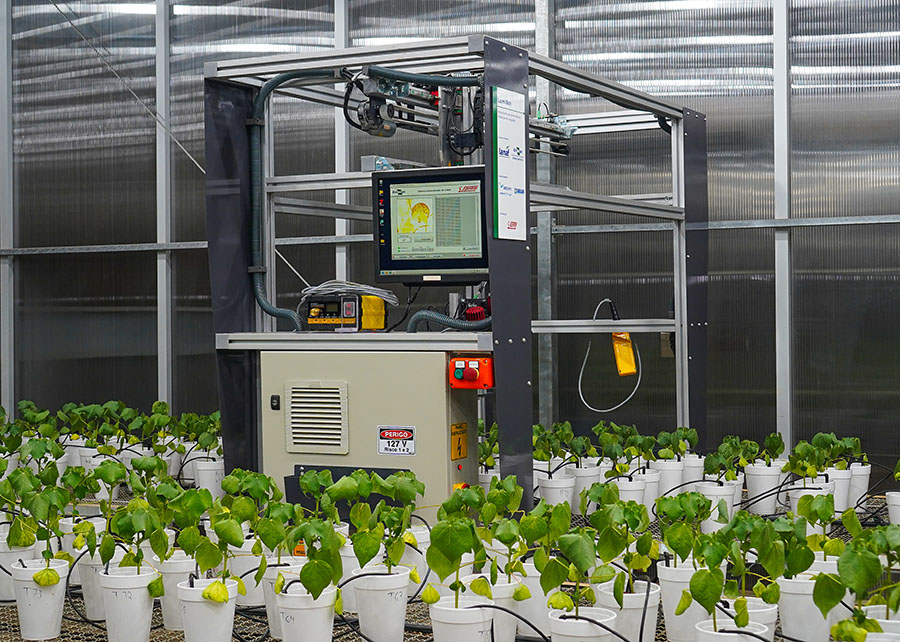
An autonomous robotic system, which operates at night, called LumiBot, is capable of generating data that allows the construction of models for early diagnosis of nematodes in cotton and soybean plants, even before symptoms appear. Once developed by Embrapa Instrumentation in partnership with the Mixed Cooperative Union for Agribusiness Development (Comdeagro), Mato Grosso, Brazil, LumiBot emits ultraviolet-visible light onto plants and analyzes the fluorescence captured in images of the leaves, with scientific cameras.
Cotton and soybean farming have enormous economic relevance for the country, as a record harvest is forecast for the 2025/26 crop year: 4.09 million tons of lint and 177.67 million tons of soybeans, according to estimates from the Brazilian National Supply Company (Conab). However, both crops face the threat of the microscopic parasite measuring 0.3 to 3 millimeters in length.
Accuracy rates above 80%
The robot is a prototype but has already shown promising results in diagnosing nematode infections in experiments in a greenhouse, when around seven thousand images were collected over three years of research.
“We were able to generate data and models that not only have accuracy rates above 80%, but also differentiate diseases caused by water stress,” says Débora Milori, the researcher who coordinates the study and the National Agrophotonics Laboratory (Lanaf).
The next stage of the study will be the development of equipment for field operations, such as adapting the optical apparatus to fit an agricultural vehicle like a grasshopper sprayer or rover vehicle.
 Agricultura e Negócios